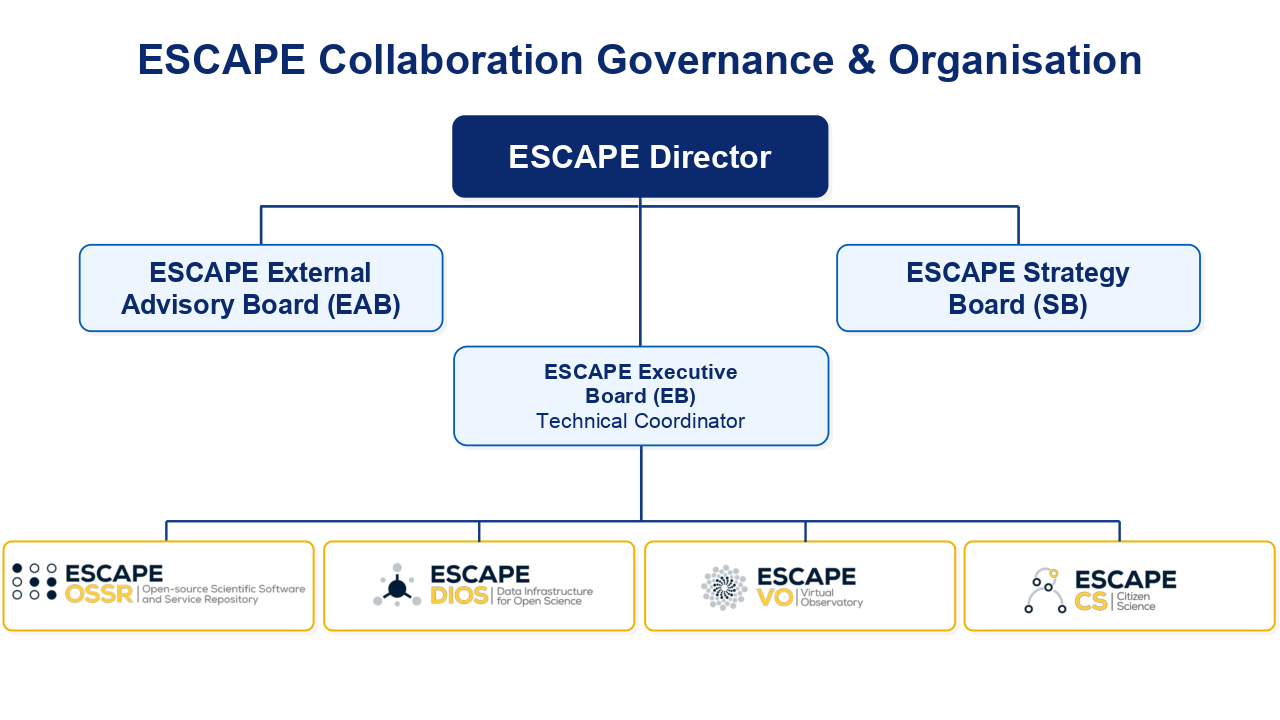
The ESCAPE Governance
The ESCAPE Collaboration brings together Research Infrastructures (RIs) in astronomy, astroparticle physics, high energy physics, and nuclear physics to address shared Open Science challenges. Its member RIs are ESFRI projects and landmarks (SKAO, CTAO, KM3Net, EST, ELT, HL-LHC, FAIR), as well as pan-european research infrastructures (CERN, JIV-ERIC, EGO-Virgo) that signed a Collaboration Agreement (find them all here).
ESCAPE is organised around several governance bodies working together to define the strategy and work program of the collaboration. The ESCAPE Collaboration is led by Director Giovanni Lamanna (CERN).
- ESCAPE Strategy Board (E-SB): includes representatives of all the RIs members of the Collaboration and is chaired by the ESCAPE Director. Its function is to is to define the strategy of the Collaboration, especially in regards to collaborative projects, coordination with partners in the European research landscape, and response to potential funding calls.
- ESCAPE Executive Board (E-EB): is composed by the technical coordinators (or equivalent) of the members of the Collaboration and the leaders of the ESCAPE working groups and is chaired by the ESCAPE Technical Coordinator. Its mission is to propose and report to the E-SB collaborative technical developments between the member RIs and coordinate their implementations.
- ESCAPE External Advisory Board (EAB) (E-EAB): includes members nominated by the Director who are asked to provide independent advice, to conduct an independent assessment of the progress being made by the ESCAPE collaboration as well as to support connection with the national thematic institutes and the scientific community at large.
The ESCAPE Working Groups
ESCAPE has four main working groups (WG) dedicated to implement the ESCAPE services into the European Open Science Cloud (EOSC):
Open-Source Scientific Software and Service Repository (OSSR): maintains and develops a curated, open-access repository for sharing, preserving, and reusing scientific software, services, and datasets, promoting FAIR principles and interoperability across research communities.
Data Infrastructure for Open Science and Virtual Research Environments (DIOS & VRE): Develops federated data management solutions and virtual research environments to enable seamless access to and analysis of scientific data and computing resources.
Virtual Observatory (VO): Supports the discovery, access, interoperability, and reuse of astronomical data through common standards and interoperable services.
Citizen Science (CS): Fosters public participation in scientific research through citizen science projects, tools, and platforms that connect researchers with wider communities.